NDT Radiography Bunker Assessment — Onshore Industrial Facility
RADXION was commissioned to perform a comprehensive assessment of an existing Non-Destructive Testing (NDT) radiography bunker at an onshore industrial facility. The purpose was to verify shielding performance, operational safety, and full compliance with international and local radiation protection standards.
Objectives
Shielding Integrity
Evaluate current shielding integrity and identify any radiation leakage paths.
Dose-Rate Compliance
Measure dose rates in controlled and public areas to confirm regulatory compliance.
Controls & Emergency
Assess access controls, interlock systems, and emergency procedures.
Recommendations
Provide actionable recommendations to enhance safety and maintain compliance.
Scope of Work
- Review of as-built structural drawings and shielding calculations.
- On-site radiation surveys using calibrated survey meters and dosimeters.
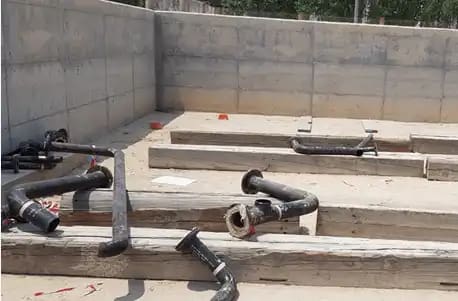
- Visual inspection of walls, doors, labyrinths, and chase penetrations.
- Functional testing of interlocks, alarms, and signage.
- Interviews and procedure review with radiography personnel.
Assessment Methodology
Step 1Document Review
- Examined bunker design drawings, material specifications, and previous survey reports.
- Verified theoretical attenuation for γ-energies up to 1.25 MeV.
Step 2Radiation Survey
- Performed ambient dose-rate mapping at 0.1 m increments around all faces.
- Conducted streaming tests at door seals, cable penetrations, and viewing ports.
Step 3Systems & Controls Inspection
- Tested door interlocks under simulated source drive conditions.
- Checked alarm thresholds, reset functions, and battery-backed lighting.
Step 4Operational Audit
- Observed routine NDT procedure including source change-out.
- Reviewed personnel training records and emergency drill logs.
Key Findings
Shielding Performance
- PassConcrete walls (0.5 m thick) and lead-lined door (> 12 mm Pb-equivalent) attenuate to < 0.02 mSv/h outside, meeting IAEA and local limits.
- MinorMinor streaming (0.03 mSv/h) detected at an unsealed cable chase—below alarm level but above desired background.
Controls & Alarms
- PassDoor interlock fully functional; emergency-stop button tested successfully.
- MinorAudible/visual alarms operate correctly; however, signage luminance falls marginally below ISO 3864 recommendations.
Procedures & Training
- PassAll operators hold valid radiographer certifications; refresher training up to date.
- GapNo record of a full-scale emergency evacuation drill in the past year.
Recommendations
Seal Penetrations
Apply labyrinth inserts or flexible lead modules to the identified cable chase to eliminate streaming.
Upgrade Signage
Replace or relume warning signs to meet minimum luminance standards.
Emergency Preparedness
Schedule and conduct a full-bunker evacuation and source-stuck drill at least annually.
Ongoing Monitoring
Institute quarterly leak-test surveys and semi-annual interlock functional checks.
Project Deliverables
- Detailed survey report with dose-rate maps and hotspot photographs.
- Updated shielding verification calculations.
- Remediation work-scope and cost estimate.
- Draft revisions to the site’s radiation safety procedures.
Conclusion
RADXION’s assessment confirms that the NDT bunker provides adequate protection under normal operating conditions, with only minor improvements required. By implementing the recommended actions, the facility will achieve enhanced safety margins, full regulatory compliance, and robust emergency readiness.